

Is Monarch: Legacy of Monsters one of the MonsterVerse’s Best Stories?
Are the two seasons of Apple TV+’s Monarch worth a watch, and what’s next?
When Godzilla was released in 2014, it launched what became known as the MonsterVerse – and introduced the mysterious Monarch organisation. Over the next decade, giant monsters smashed cities, fought on aircraft carriers, drilled holes into the Hollow Earth, and occasionally teamed up with each other. It has been entertaining, chaotic, and often spectacular, and I’ve loved it. But then I’m generally a sucker for giant things fighting other giants things.
Until recently though, it was not always clear whether the franchise could sustain itself outside blockbuster films. TV spinoffs are very hit and miss.
That made Monarch: Legacy of Monsters an interesting gamble. A television series set inside the MonsterVerse sounded like it could expand the world in fascinating ways. But it could also have been some people in a bunker talking about Godzilla with occasional footage of kaiju fights in a TV equivalent of Ice Cube’s legendary War of the Worlds film.
Thankfully, the series turned out to be far more ambitious than that. It even has a great budget, and a talented cast.
How the show fits in with the movies
After two seasons, Monarch has become one of the strongest things the MonsterVerse has produced. Season one laid the foundations with mystery, conspiracy, and a surprisingly thoughtful approach to the franchise’s giant creatures. Season two then improved on almost everything. At least in my opinion. The scale became larger, the pacing became stronger, and the monsters themselves played a far bigger role.
The series sits between the events of Godzilla and the later MonsterVerse entries like Godzilla vs. Kong and Godzilla x Kong: The New Empire. Although it actually spans a huge amount of time. But rather than focusing on the destruction caused as big beasts battle it out in major cities, it explores the secretive organisation Monarch, which has spent decades tracking giant creatures known as Titans.
The split timelines works well
The story follows two main timelines. In the 1950s, a younger Lee Shaw works alongside scientists Bill Randa and Keiko Miura as Monarch begins uncovering evidence that enormous creatures exist beneath the surface of the world. In the modern timeline, Cate Randa discovers her family has deep connections to Monarch and becomes pulled into a dangerous hunt involving secrets, hidden facilities, and monsters that most of humanity still barely understands and has only recently properly become aware of.
The dual timeline structure could easily have become messy, but, happily, it doesn’t. The older storyline, in particular, often feels like the emotional core of the series. The 1950s scenes have a sense of mystery, adventure, and discovery that gives the show much of its identity, and I really liked it.
There is also a kind of competence to those sequences that makes them extremely enjoyable to watch. Shaw, Keiko, and Bill feel like intelligent professionals trying to understand something enormous and dangerous rather than characters stumbling from crisis to crisis – which I occasionally felt with the more modern timeline.
The characters and casting are generally great
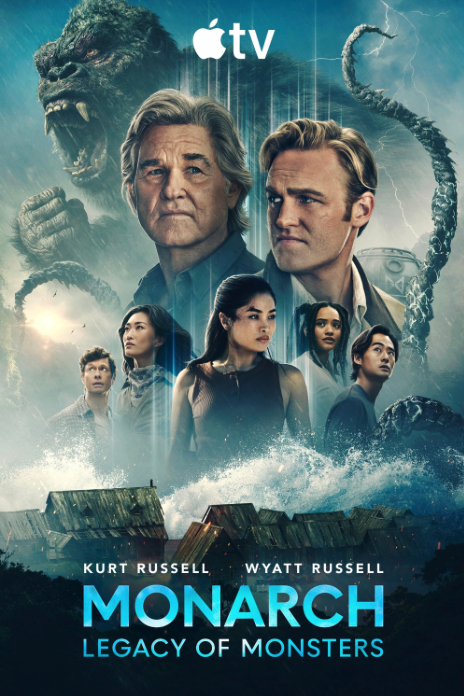
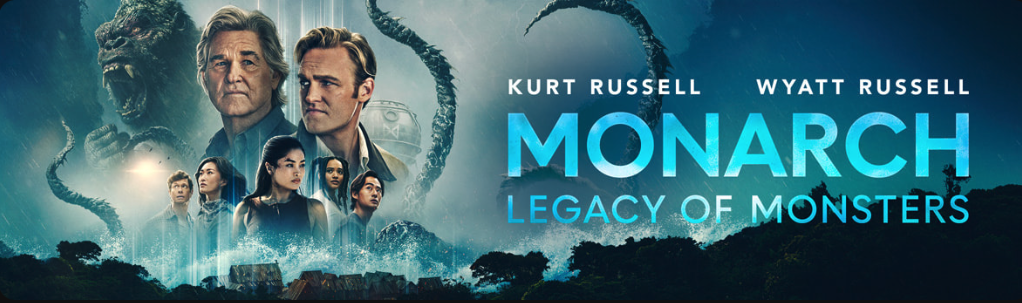
Kurt Russell and Wyatt Russell were also perfectly cast as the older and younger versions of Lee Shaw. I really like Kurt Russel, especially the films he did with John Carpenter when I was growing up. I’d seen Wyatt Russell in Marvel stuff and thought he seemed cool, but had never realised he was Kurt’s kid until this. It’s a perfect pairing if you want two decent actors playing younger and older versions of themselves. There must have been a lot of high-fiving in the Monarch show casting department when they agreed.
Shaw has the weary, experienced energy of someone who has spent decades dealing with impossible situations, but he also remains practical and grounded. Even when the story becomes increasingly bizarre, Shaw somehow keeps it believable.
Bill and Keiko are equally important to why the show works so well. Their storyline gives Monarch a sense of history and purpose beyond simply being “the secret monster agency”. By the second season, the relationship between the three characters had become more compelling than I expected from a television spin-off tied to giant monster films. The trio were probably my favourite characters.
Another surprisingly enjoyable character was Tim. He could easily have become comic relief or an annoying bureaucrat, but instead he ends up feeling like exactly the sort of person a real organisation like Monarch would need. The investigative and procedural elements often work just as well as the monster action and I enjoyed all the stuff when they are in some Monarch control room or other tracking monsters and doing secret organisation stuff.
Fortunately, the monster action is also excellent.
Big effects and big fights
One of the biggest complaints about the first season was that viewers wanted more Titans belting the hell out of each other. Season one was sometimes more interested in mystery and atmosphere than giant battles, which worked for me, but season two clearly understood that audiences also wanted to see the creatures in action. The second season delivers much more spectacle without losing the sense of scale that makes the Titans feel dangerous.
The visual effects are consistently impressive for a television production. Apple clearly spent pots of cash on the series, and it shows. The Titans feel enormous, heavy, and genuinely threatening. Especially when some tiny and puny human is scampering around their feet. Some television shows struggle to make CGI creatures feel part of the environment, but Monarch generally avoids that problem. The fights have weight and scale, particularly in the second season.
The Titans are not constantly on screen, but when they do appear, the scenes usually matter. The show remembers that Godzilla and the other creatures are supposed to feel awe-inspiring rather than ordinary, and the balance is done well.
That said, the series is not perfect.
What I wasn’t so keen on
The weakest aspect throughout both seasons, in my humble opinion, is probably the younger trio of Cate, Kentaro, and May. None of them are terrible characters, and they improve over time, but their sections of the story occasionally become more melodramatic than the rest of the show.
There are moments where they feel younger than they are supposed to be, particularly when compared with the calm professionalism of Shaw, Keiko, Bill, or Tim. May is like an angry teen most of show, and Kentaro and Cate are also a bit dramatic. It could be that I am a repressed Brit, but they sometimes feel like they are trying to make a point to the grown ups and sometimes feel on the verge of stamping their feet and storming off.
It never ruined the series for me, but there were definitely times when I found myself more eager to return to the Monarch storyline or the 1950s timeline than to another argument between the younger characters. Thankfully, season two balances things better and gives the overall story much stronger momentum.
The immediate future of the MonsterVerse
As of now, Apple has not officially confirmed a third season, but the ending of season two clearly leaves the door open for more stories. Whether that means Monarch season 3, remains to be seen.
The next film – Godzilla x Kong: Supernova – is coming out in 2027. Which is exciting.
A spin-off focused on Lee Shaw has also been announced. According to Apple TV press, “the spinoff series will follow the story of Colonel Lee Shaw, an American operative who, in 1984, went on a secret mission behind enemy lines in an attempt to stop the Soviets from unleashing a horrific new Titan big enough to destroy the U.S. and turn the tide of the Cold War.”
A Shaw-focused series exploring Monarch during the Cold War years could be awesome. The older timeline has consistently (again, in my opinion) been the strongest part of the show, and there is clearly still plenty of history left to explore involving Monarch’s early encounters with Titans.
With new films and spin-offs, coupled with every studio wanting to develop their own ‘-verse’, I think there will be a season 3.
Final thoughts
I really enjoyed Monarch: Legacy of Monsters. It found a way to combine conspiracy thriller, science fiction, monster spectacle, and character drama into something fun. Plus, obviously, it had giant monsters hitting each other.
By the end of season two, I was no longer watching simply because I like giant monsters. I was watching because I genuinely wanted to know what would happen next to Monarch, Shaw, and the strange world they had uncovered beneath the surface of the Earth.
I look forward to more. If you enjoyed any of the movies, you should check it out.
It is refreshing to see a MonsterVerse story that dives deeper into the organization behind the chaos rather than just focusing on the giant battles. While the original films were spectacular, this series seems to finally give the franchise the grounded character drama it needed to truly sustain itself. I am curious if the upcoming plot points will explore the organization’s history even further.