


Funny Sci-Fi Books: Brilliant Reads That Will Actually Make You Laugh
Science fiction has a bit of a reputation for seriousness. After all, it deals in vast ideas, existential threats like alien invasion, post-apocalyptic scenarios, and the long-term fate of humanity. It is not, at least at first glance, a genre built for comedy.
But all of those topics have funny books written about them, and many are classics. There are plenty of humorous sci-fi TV shows, like Futurama, Rick and Morty, Futureman, The Orville, and films – the awesome Galaxy Quest, Idiocracy, Men in Black (the first one), and Guardians of the Galaxy; but discussions around funny books seem more limited.
From dry British absurdity to chaotic space adventures and quietly sarcastic artificial intelligences, humour has always had a place in science fiction. And more people should read them.
Here are some of the funniest science fiction books and authors, from the genre’s defining classics to more modern favourites. (All of these are personal opinions based on what I’ve read.)
The Masters of Sci-Fi Comedy
Douglas Adams, The Hitchhiker’s Guide to the Galaxy and Dirk Gently
If there is a single writer who defines humorous science fiction, it is Douglas Adams. When you ask someone (especially a Brit) to name a funny science fiction writer, they will probably say Adams.
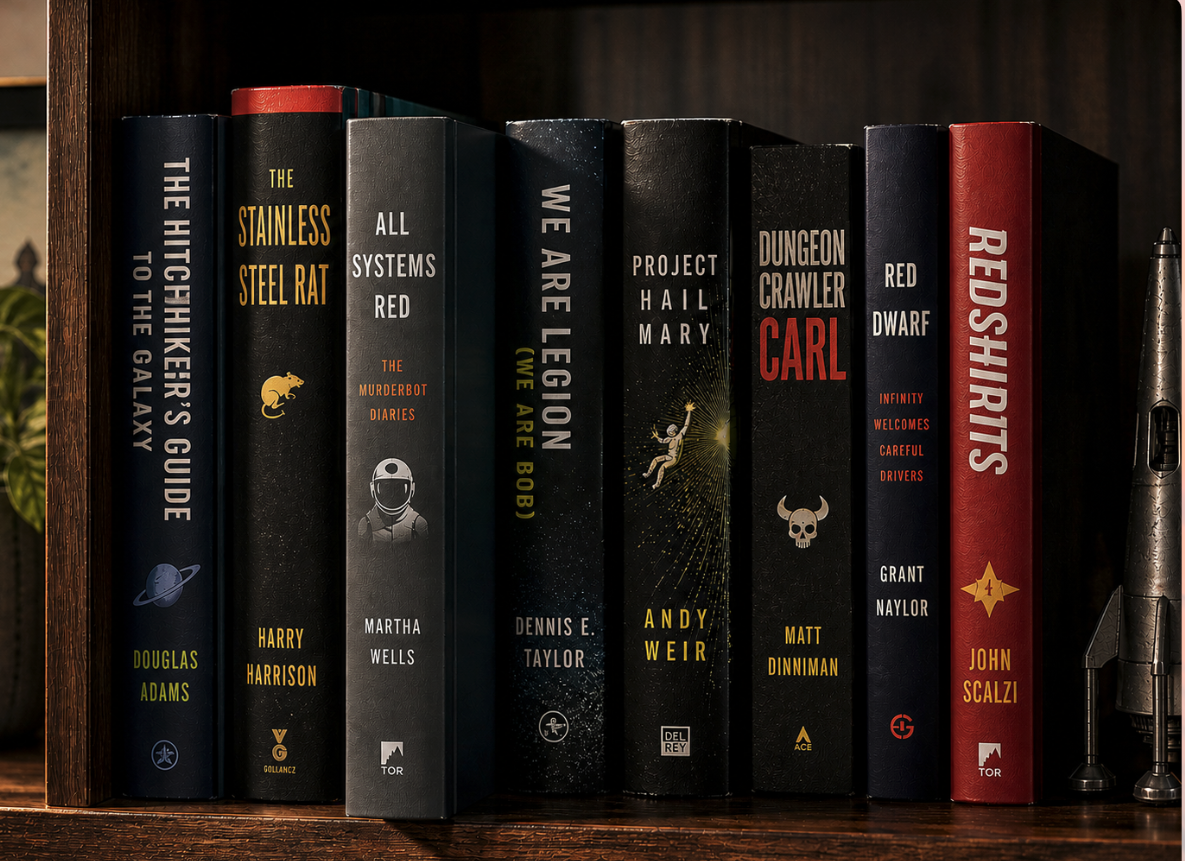
The Hitchhiker’s Guide to the Galaxy remains the benchmark. I read it when I was nine years old, and it got me into sci-fi. Its humour is built on the philosophy of absurd logic taken to its extreme, whether that involves a supercomputer calculating the meaning of life, a species that justifies mass murder with bureaucracy, a robot so intelligent its mundane existence depresses it, or a spaceship powered by improbability itself.
What makes Adams stand out is not just that he is funny, but that the jokes are embedded in the ideas and mixed with philosophy. And they are superb ideas. The humour comes from the science fiction, not from characters stopping to make jokes.
Decades later, most attempts at humorous sci-fi are still measured against him. I adore Douglas Adams and all his work. His Dirk Gently books are also brilliant.
Harry Harrison, The Stainless Steel Rat and Bill, the Galactic Hero
After the Hitchhiker books (there were only three out then), I got into The Stainless Steel Rat. Where Adams leans into absurdity, Harry Harrison goes for satire.
His two best-known comedic works take slightly different approaches.
The aforementioned Stainless Steel Rat follows a charming criminal as he navigates a futuristic society, while Bill, the Galactic Hero, is a pointed parody of military science fiction. Both of the first books in each series are brilliant, and I highly recommend them. (The sequels are more down to individual preference and are fun, but they decline in my opinion.)
The humour here is broader and sometimes rougher, but it lands because it targets familiar sci-fi tropes and dismantles them from the inside. Harrison wrote a lot of other books, and he was consistently great, but these two are his funniest.
Rob Grant and Doug Naylor, the Red Dwarf books
You may already know the Red Dwarf TV show, but did you know there are some excellent books? If you don’t know Red Dwarf – go and watch it now.
The Red Dwarf novels, beginning with Infinity Welcomes Careful Drivers, are superb. They are based on the television series, but they are not simple adaptations.
Written by Rob Grant and Doug Naylor under the shared name Grant Naylor, the books expand on the original premise and, in some cases, improve on it. The tone remains the same. A small, dysfunctional and quirky crew are drifting through deep space in a massive ship, dealing with increasingly absurd situations.
What makes the novels stand out is how well the humour translates to the page. Without the constraints of television, the ideas can be pushed further, and the internal thoughts of characters such as Lister and Rimmer become a larger part of the comedy. There are some great ideas explored.
For readers who enjoyed the series, they are more than companion pieces. The books are funny, but they are also great sci-fi.
Kurt Vonnegut, all his books
Kurt Vonnegut occupies a different corner of the genre.
His work, including Slaughterhouse-Five, is often described as satirical or literary science fiction, but it is consistently funny in a dry, understated way. The humour is rarely the main point, but it is always there, usually sitting alongside something much darker.
I wouldn’t say his books are laugh-out-loud funny, but they are amusingly written and follow absurd ideas to sometimes extreme conclusions. In Galapagos, for example, a tour boat to the eponymous islands gets stranded after a global disaster, and the passengers evolve into different creatures over millennia. The Sirens of Titan features an alien invasion as witnessed by a bored billionaire. Cat’s Cradle is about a substance called Ice 9 that turns all water solid and could end the world.
If Adams represents pure comedic sci-fi, Vonnegut shows how humour can sharpen rather than soften the ideas. Both take an idea and run with it, but Vonnegut’s humour is a bit darker and more wry.
Modern Sci-Fi That Actually Makes You Laugh
John Scalzi, Old Man’s War, Redshirts, and others
John Scalzi is often associated with humour, although it varies by book.
Old Man’s War is not primarily comedic, but its tone is accessible and often light. It is a fun read and a great series. Redshirts, on the other hand, leans heavily into meta-humour, playing with the idea of expendable characters (always in red shirts) in a Star Trek-style universe.
That approach works for some readers and less so for others (I preferred Old Man’s War), but it is one of the clearer examples of modern sci-fi deliberately built around a comic premise.
Andy Weir‘s The Martian and Project Hail Mary
Andy Weir does not write comedy in the traditional sense, but both The Martian and Project Hail Mary are consistently funny. I frequently laughed thanks to the main characters and their outlook on life.
The humour comes from the voice. His protagonists tend to respond to extreme situations with sarcasm, problem-solving, and a refusal to panic, creating a steady stream of understated comedy alongside well-researched science.
I haven’t read Artemis because it has consistently received bad reviews, but the core appeal of his style remains clear in his best work.
Martha Wells and The Murderbot series
The Murderbot series, starting with All Systems Red, takes a different approach to humour.
Rather than overt jokes, the comedy comes from the internal monologue of a security android that would prefer to be left alone to watch entertainment media. The tone is dry, self-aware, and often unexpectedly sharp. They are also good sci-fi adventures.
It is a good example of how modern sci-fi tends to embed humour in character rather than structure.
Pure Chaos and Fun
Barry J. Hutchison and Space Team
Space Team is built around fast pacing and constant escalation.
The humour is more immediate than in the earlier authors and can sometimes veer toward the slightly puerile. It relies on mismatched characters, poor decisions, and increasingly chaotic situations. It is less concerned with satire or ideas and more focused on being consistently entertaining.
I love this series and probably laughed out loud (literally) more frequently with this series than anyone apart from Adams. Cal Carver is a superbly funny protagonist.
For readers looking for something light and genuinely hilarious, it is one of the more reliable modern series.
Dennis E. Taylor – The Bobiverse
The Bobiverse series, beginning with We Are Legion (We Are Bob), combines big science fiction concepts with a relaxed, conversational tone.
The humour is not constant, but it runs through the entire series. Much of it comes from the central idea of a single consciousness duplicated across multiple versions of itself, each reacting slightly differently to the same situations. If you enjoyed Andy Weir’s stuff, you will probably like this.
It is a good balance between idea-driven sci-fi and accessible humour.
Matt Dinniman and Dungeon Crawler Carl
Dungeon Crawler Carl takes a deliberately absurd premise and fully commits to it. It is the only lit RPG series I have ever read, and it is manic fun. Basically, aliens flatten the Earth and turn it into a series of dungeons and worlds, where the remaining humans (and sometimes pets) have to fight to stay alive.
The result is chaotic, often ridiculous, and consistently funny. It blends game mechanics, survival scenarios, a Running Man approach to future entertainment, and exaggerated characters into something that feels closer to a dark comedy than traditional science fiction. It’s both amusing and bleak at the same time.
It is also really different from most of the other books in this article, so check the genre and description first. The audiobooks are also superb and highly recommended.
The Borderline Case That Still Belongs Here
Terry Pratchett
Most of Terry Pratchett’s work sits firmly in fantasy, but his style overlaps so heavily with humorous science fiction that he is difficult to leave out. Plus I love Pratchett and in my personal literary firmament, he and Adams sit above all others.
His collaboration with Stephen Baxter on The Long Earth moves more directly into sci-fi territory (it’s not particularly funny though), but even outside of that, his influence on comedic speculative fiction is hard to ignore. He also wrote a couple of pure sci-fi comedy books, but they never hit the heights of the Discworld.
Why Humour Works So Well in Science Fiction
At its best, humour in science fiction works brilliantly. If someone finds getting into science fiction a bit difficult, one of the above books should do the trick.
The genre’s authors like to explore ideas, and humorous sci-fi often takes ideas to extreme lengths and then throws a likeable everyman into the chaos to see how they react. I’m obviously a huge fan of serious, literary, philosophical work as well, but sometimes the absurd, farcical, and satirical can be just as valid a way to investigate a sci-fi concept. Plus, it’s good to have a laugh.
Science fiction may take itself seriously, but it has always had a good sense of humour.
This post has affiliate links. Quite a few.