





Future Man: Surprisingly Smart Sci Fi Disguised As Hilarious Chaos
I wrote recently about how I was about to finish Future Man soon. Well, that’s done, so here’s a review. I sweat for this website.
Future Man came out on Hulu in 2017. It was created by Kyle Hunter, Ariel Shaffir, Seth Rogen and Evan Goldberg, a group that has built an entire career out of mixing the smart and the stupid in equal measure. They did Sausage Party, which posed some fairly deep questions, then had a really graphic food orgy. I loved it.
But it gives you an idea of what to expect. Only with humans and time travel. Ok, it gives a vague idea.
What is Future Man about?
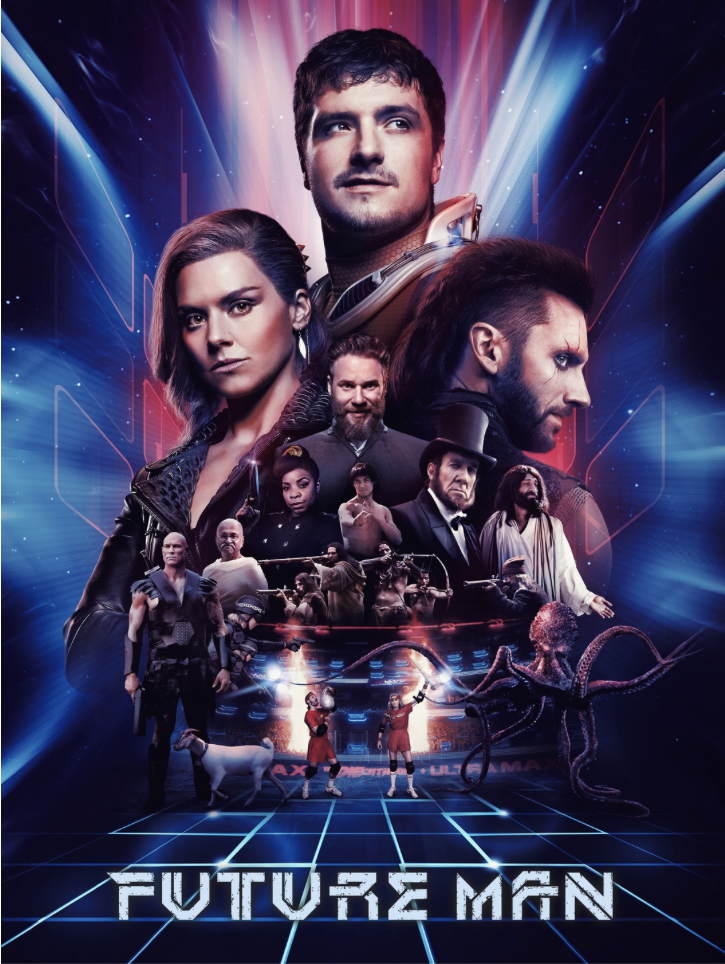
The setup is simple. Josh Hutcherson plays Josh Futturman, a low level janitor and average gamer who finishes an impossibly difficult video game called Biotic Wars. The moment he does, two figures appear in his bedroom. Tiger and Wolf, played with manic precision by Eliza Coupe and Derek Wilson, step out of the game to inform him that it was a recruitment test. They need him to save the future.
To save you some time – if you found the show funny and intriguing up till this point, you will probably like the show. If you find the gag that happens when they meet a bit too much, then maybe you won’t like it.
What follows is a time bending quest that gleefully smashes together The Last Starfighter, The Terminator, Back to the Future, and anything else the writers felt like throwing into the mix. It sounds ridiculous because it is ridiculous, but that is also the point. The show never pretends otherwise.
Over the next three seasons, they have a lot of adventures and then it does that rarest of things these days – it wraps things up nicely.
It is really well made
The talent involved gives it a surprising level of craftsmanship. Hutcherson’s everyman performance provides an anchor for the madness around him. Coupe delivers a tight lipped warrior persona that grows funnier as her character develops and softens. Wilson starts big and only gets bigger, turning Wolf into one of the most unpredictable characters in recent television. His character is awesome.
Trio’s dynamic drives the show far more than any time travel logic. That said, the writing team did keep track of its paradoxes. I read that they had an entire system of whiteboards dedicated to continuity, which allowed the series to play with time loops without drifting into incoherence.
Future Man also had a knack for episodes that felt like standalone parodies while still pushing the story forward. One week it might poke fun at dystopian futures, the next it would dive into 1960s counterculture, and then it would spiral into an alternate present where small choices have gone very wrong. There a whole bit where Wolf gets stuck in the late 80s and early 90s that is probably one of my favourite bits of TV.
The show clearly loved the genres it was mocking. That affection helped keep it from turning into a cynical sketch series and gave it just enough emotional weight to make the characters matter.
What did other people think?
Critics responded warmly. The first season scored in the low eighties on Rotten Tomatoes, while seasons two and three both ended up with perfect scores of 100. I would agree, except I would give the first season a higher rating. I think I’m the perfect audience for the show, though.
Reviewers praised its pace, its willingness to go all in on absurdity, and the strong chemistry between the leads. Some felt the humour was relentless and occasionally juvenile, but they also acknowledged that it was deliberate. Future Man was designed as a fast moving piece of comedic science fiction, not a serious exploration of time travel theory. But like Hitchhiker’s or Red Dwarf, it can also get quite deep and explore some interesting ideas.
Audiences who found it (and got throught the first episode) tended to stick with it. Viewers consistently praised the way the characters grew over time, especially Wolf’s strange and memorable arc. They also appreciated the fact that the series did not drag out its premise. The writers had a story they wanted to tell and wrapped it up in three seasons. The finale in particular earned admiration for closing on a note that felt both silly and satisfying.
Future Man should be better known. I just found out about it
Future Man never became a mainstream phenomenon. It arrived on a platform that, at the time, had a smaller global footprint, and its marketing never fully conveyed what made the series special. Yet that obscurity has helped it become a cult favourite. It is the sort of show people discover by accident and then recommend with enthusiasm. Exactly as I am doing.
There is something endearing about its commitment to going big at every opportunity. It embraces time travel chaos, low brow jokes, high concept ideas and emotional bits without worrying about how neatly they fit together.
As a piece of sci fi television, it sits in an interesting space. It is knowingly silly, yet the intelligence behind the writing is obvious. And thanks to a cast that understood exactly what kind of show they were in, it manages to keep surprising the viewer long after the initial premise settles down.
I only found out about Future Man in the last few weeks and was immediately ridiculously intrigued. It sounded like exactly the kind of thing I would enjoy. I don’t know why the marketing didn’t reach me, but it was an awesome find and I hope this post helps get it more viewers. I want more of this kind of TV.
(I watched Future Man on Netflix in Thailand. But I am sure you can find a way to watch it otherwise.)